
Heaven Knows
2025
Plexiglass, bamboo, palm leaves, concrete blocks, metal, 3D-printed PLA, monitor, single-channel video (12:00 mins looped), audio (9:34 mins looped), red stoneware, raffia, wire
Dimensions variable
Supported by the A.I.R. Gallery Fellowship program; with assistance from the Australian Government through Creative Australia, its principle arts investment and advisory body.
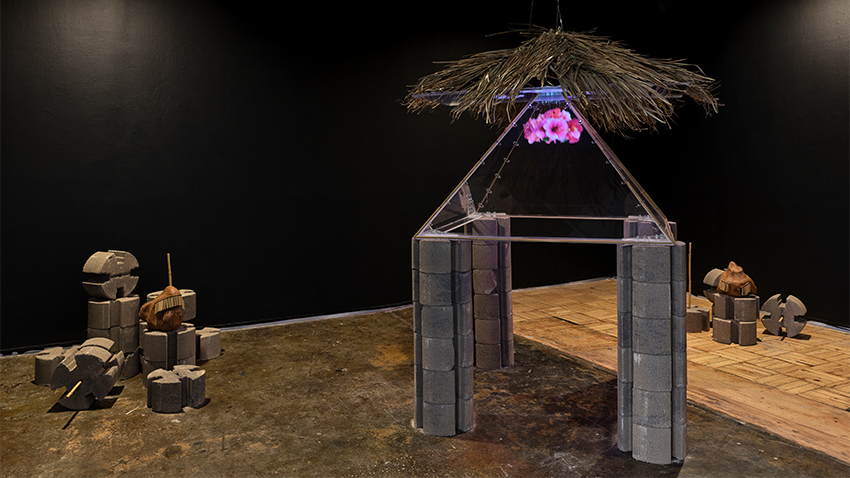
Borrowing from neuroscience and mourning rituals from Indigenous Philippine folk religions, Heaven Knows considers how grief compels the brain to enter a state of motivation through a yearning for the lost connection. Garcia applies this research to her own personal narrative to create a neural remapping of her grief, one which travels through the realm of instinct to find meaning in new and metaphysical realities. Clay artifacts and a holographic installation draw on both ancient and digital technologies to participate in a nonlinear continuum that carries the living past forever forward.
Heaven Knows expands upon Garcia’s research and practice in martial arts to consider technologies of warfare that guard against paranormal rather than physical threats. A student of Inosanto LaCoste Kali, she cites the system’s final, twelfth category, a study of immaterial weapons—mental, emotional, and spiritual training tools that provide esoteric methods of protection. In so doing, she acknowledges the existence of a parallel spirit world and the permeability of the earthly and metaphysical planes, posing a unique series of protocols to engage with the upper echelon.
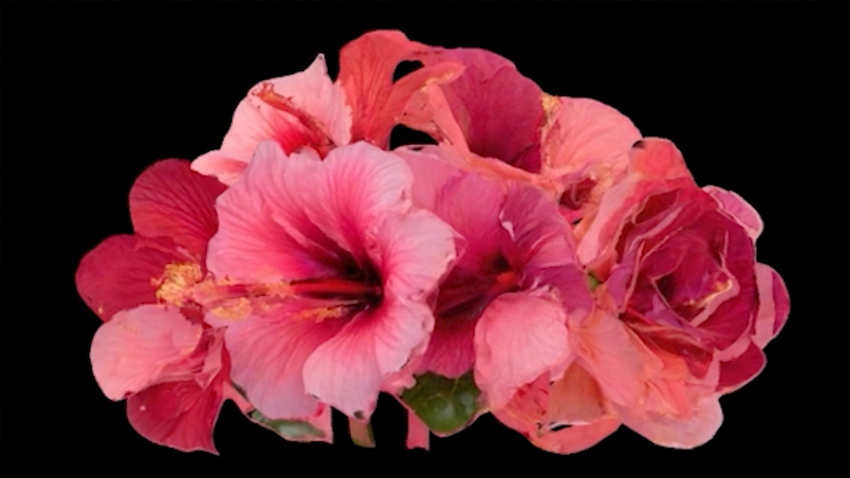
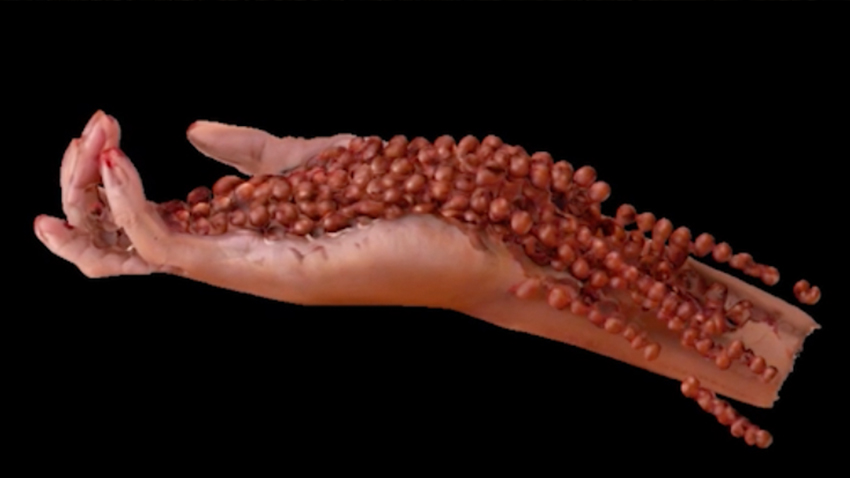

3D models AI-generated from prompts using verbatim transcript
from pyschic readings to communicate with my late mother
The central artwork in the exhibition is a pyramid-shaped installation fabricated from bamboo, raffia, and steel iron, natural materials native to the Philippines. It references funerary rites widespread throughout the Archipelago, particularly the custom of guarding the departed from malevolent spirits by interring them with talismans, weapons, and agricultural tools. These ancient cultural rituals combine with the aesthetics of contemporary technology: a synthesized soundscape composed by Sonia Manalili surrounds the installation, while a 3D-rendered video is displayed within the pyramid’s transparent panes. Integrating digital imagery sourced from mediumship readings, the hologram attempts to commune with and guard Garcia’s mother in the spiritual realm, but also intends to conjure a speculative record of her in the afterlife. In lieu of remembrance through material records and past memories, Garcia builds a metaphysical archive to coalesce future and after-death experiences. Through this psychic collaboration, magic and religion mingle to annihilate space and time, reinforcing an omnipresence of the ancestral.
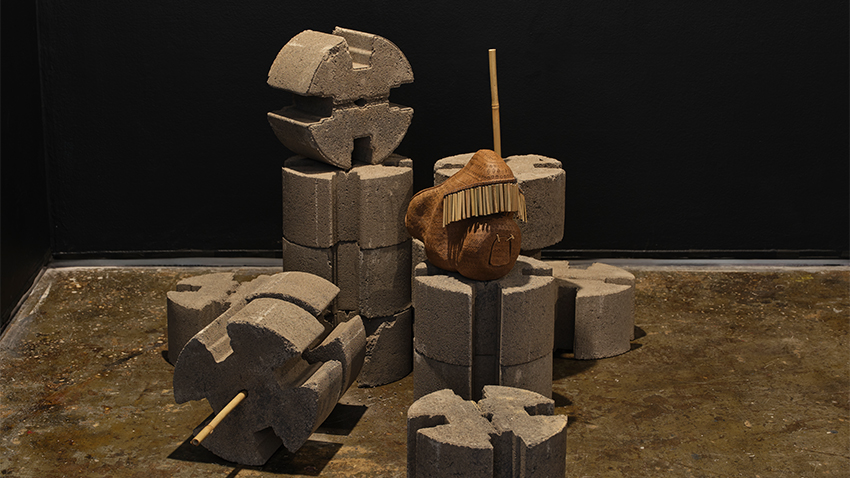
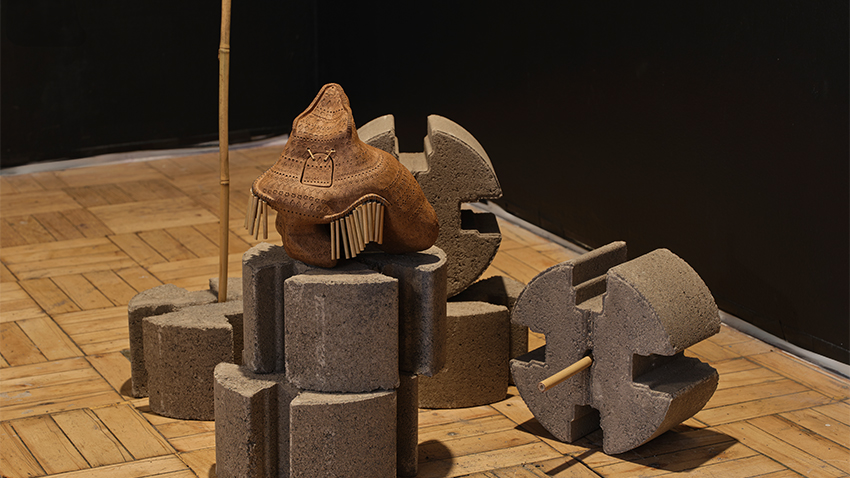
Acknowledging the symbiotic ways in which the living and the dead might protect each other, Garcia also offers a series of ceramic pieces that cite Lab-labón (or Adug): small incised clay houses where spirits are believed to dwell. Traditional to the Indigenous Tingguian, these houses are typically stored among rice jars in the belief that residing spirits multiply the rice. Offerings are deposited inside as a gesture to ask for the protection of crops and to ensure a good harvest. Garcia’s renditions are incised in an improvisational manner, using custom 3D-printed stamps modeled from designs on earthenware sherds dating back to the Iron Age ca. 500 - 200 B.C.
Exhibition History: A.I.R. Gallery (2025)
Image Credit: Installation photos by Matthew Sherman, courtesy of A.I.R. Gallery